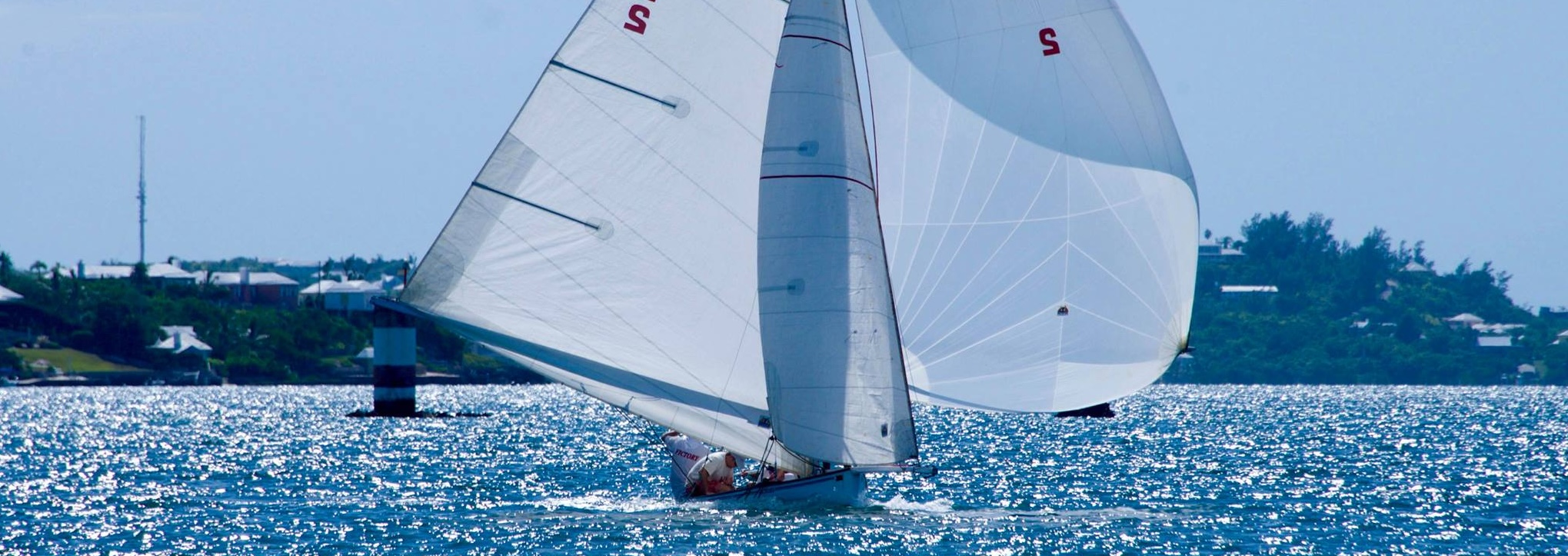
Objective: To understand how and why a boat floats.
At its most basic level, a boat is an object that floats and can be used for transport or recreation. The early boats would have been based on logs, probably in the form of a couple of logs lashed together somehow. The Bermudian definition is somewhat more humorous – a boat is a hole in the water into which you throw money. This is surprisingly accurate, as a boat is literally a hole in the water and the reason that it floats is due to the water trying very hard to fill that hole back up again.
This was initially figured out by Archimedes of Syracuse over 2000 years ago and the fundamental concept is named in his honour. Archimedes’ Principle is probably the oldest law of physics there is. All the other natural ‘laws’ figured out by the ancients have not stood the test of time, but this one has. Being based on an island, we spend a lot of time in and on the ocean, so it is an important one to become well versed in.
It was famously discovered by Archimedes while in his bathtub. There are a number of different stories as to why he was having a bath, one of the most interesting was that he was trying to relax and figure out how to find the volume of a crown that a blacksmith had made for the king in order to determine whether it had been made from pure gold or alloyed with a cheaper metal. He filled the bathtub with water (and possibly bubble bath and a rubber duck) and then climbed in. To his horror, water overflowed and flooded his bathroom.
Archimedes’ genius was realising that the overflow was caused by him displacing his own submerged volume of water. With hindsight this is blindingly obvious. As an object is submerged into the water, the water that was where the object now is must go somewhere else after all.

A bird in one of Aesop’s Fables also understood this as he dropped stones into a narrow hollow so as to raise the water level enough that he could drink. Surprisingly, the ravens in the Tower of London have been observed doing this too.
As he had now solved the problem of how to measure of the king’s crown he was very excited and according to legend, ran naked down the streets of Syracuse shouting ‘Eureka!’, which is Greek for I have it. To this day, scientists and engineers often use the expression ‘a eureka moment’ to describe a flash of inspiration or discovery.
However, this is not yet Archimedes’ Principle. He had figured out that an object displaces water and could measure or calculate this. The next step was to realise that the weight of the water that has been displaced by a floating object was exactly equal to the object’s weight.
In his book, ‘On Floating Objects’, he wrote:
“Any object, totally or partially immersed in a fluid or liquid, is buoyed up by a force equal to the weight of the fluid displaced by the object.“

The force of buoyancy (upthrust) is exactly equal to the weight of the water displaced. The red box represents the water that has been displaced by the block. This lump of water weighs something! If the water is fresh, each litre of it weighs exactly 1.0 kg. Salt water would weigh a little bit more as it is denser.

A really useful exercise is to use a variety of regular shapes and a measuring cylinder to show that their volumetric equations are correct. E.g. the volume of a sphere is determined by:
So, drop a ball into a beaker of water and measure the ‘apparent’ change of volume. It should be exactly the same value. Of course, this is not how the equations were derived, but it is somewhat reassuring that mathematical theory matches empirical reality!
However, this displaced volume is not Archimedes’ Principle. It is that this displaced volume of water causes an upwards force on the object displacing it. He figured out that the upwards force of buoyancy is exactly equal to the weight of the water displaced. The greater the volume of displaced water, the greater the buoyant force (often called “upthrust”). To fully appreciate how the volume affects the buoyancy of an object try submerging a) a tennis ball and b) a beach ball…

Bermuda’s tall ship is the “Spirit of Bermuda”. She floats because the upthrust from the displaced water from her underwater volume is identically equal to her weight. If her weight increases, then the weight is greater than the upthrust and she sits lower in the water until the increased displacement once again balances her weight. “Spirit” was built out of wood in Maine based on a design of a “Ballyhoo schooner” found on a painting in the National Maritime Museum of London, which shows one of the easiest examples of the now ubiquitous Bermuda rig (triangular sails). The original Bermuda Sloops were considered too unsafe to replicate. The project was the brainchild of Malcolm Kirkland.
So what causes this force of buoyancy? There are two easy ways to look at it:
a) It is due to the hydrostatic pressure caused by the depth of the submerged object spread over the area. Every object has a depth to it. Very thin objects have very little buoyancy.
b) the water displaced upwards by the object is trying to return to where it came from as water always runs downhill due to gravity. To get a sense for this, go to the beach with a spoon and start frantically digging a hole in the ocean…

Mathematics
There are generally two types of problem that involve Archimedes’ Principle and they are dependent on whether the object is totally submerged or floating on the surface. Submerged is the easiest. Assume that the fluid involved is water for simplicity.
1 – Submerged
There are two ways that an object can remain submerged, a) it is denser than the water and has sunk or b) it is buoyant but held below the surface by a mooring rope. Either way the weight of the object is simply its mass times gravity, and the buoyant upthrust is the weight of the water displaced. The volume of water displaced for a submerged object is identically equal to the volume of the object.
For objects that are held down, simply use Newton’s 1st Law to realise that the forces up must balance the forces down and calculate either the tension in the rope.
Example: A cork of mass 10 g and density 250 kg/m3 is held under the surface of water by a length of cotton string. What is the tension in the string?